LABEL STYLES - ALBUMS
WORLD RECORD CLUB
WORLD RECORD CLUB
The World Record Club (WRC) was the brainchild of John Day, an Australian advertising copywriter working in London, and Norman Lonsdale, a distinguished scion of the British merchant banking firm Kleinwort Benson Lonsdale. The club commenced operations in London, England, in January 1956.
After a difficult first year, WRC began to find its feet in 1957. Encouraged by the club's growing success, Day turned his attention to Australia, establishing a Melbourne-based counterpart later that year. He eventually became its chief executive in 1963, while a New Zealand club followed several years after the Australian launch.
WRC issued LPs and tapes, predominantly classical and jazz titles, through a membership-based mail-order system. In Australia, manufacture was handled by EMI (Australia) through a 10 year agreement signed 3 April 1959. EMI (Australia) ultimately purchased WRC from EMI UK in early 1969, eventually assuming full control in 1975.
With the WRC becoming considerably less profitable—partly because changes to sales tax arrangements imposed the full tax burden on stock supplied through record clubs—EMI (Australia) made the decision in early 1983 to relocate the club from Melbourne to Sydney in an attempt to make it viable. The club relocated to EMI's Homebush premises, with its master tapes transferred to the tape basement at 301 Castlereagh Street, Sydney.
The following year, WRC and its principal rival, the CBS-owned Australian Record Club, were acquired by International Direct Marketing. The company was led by Brian Harris, former general manager of EMI (Australia), and Daryl Harbrecht, who had headed CBS Records' Australian Record Club for twenty years. The two clubs were subsequently consolidated under Record Clubs of Australia (Pty Ltd), with former EMI employee Aub Hogno appointed to oversee the combined operation.
Despite its promising early performance, the combined operation did not remain financially successful for long, entering receivership in February 1986. The business was acquired from the receiver by direct-marketing and media entrepreneur Joseph Schwartz, head of the Winns group of companies, who injected fresh capital in an effort to revitalise the club.
In late 1989, Record Clubs of Australia was purchased by Time Life Books, creating a direct-marketing operation that effectively challenged Reader’s Digest for the position of Australasia’s largest direct marketer of recorded music.
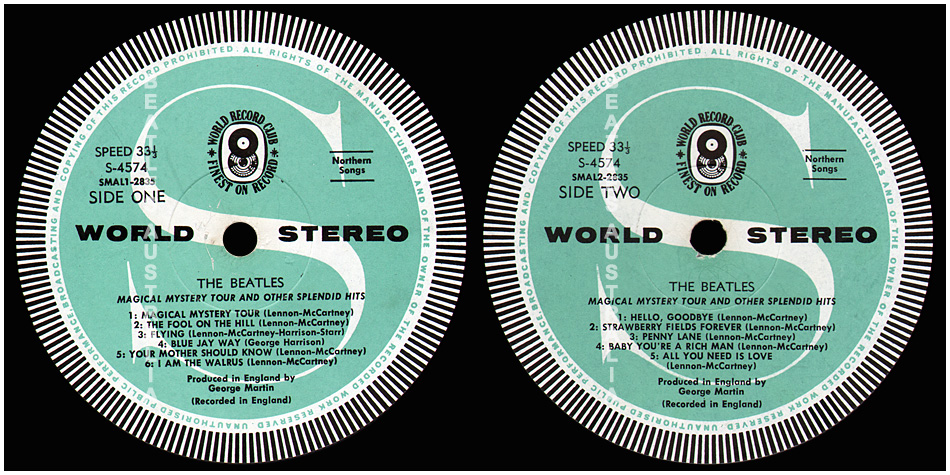
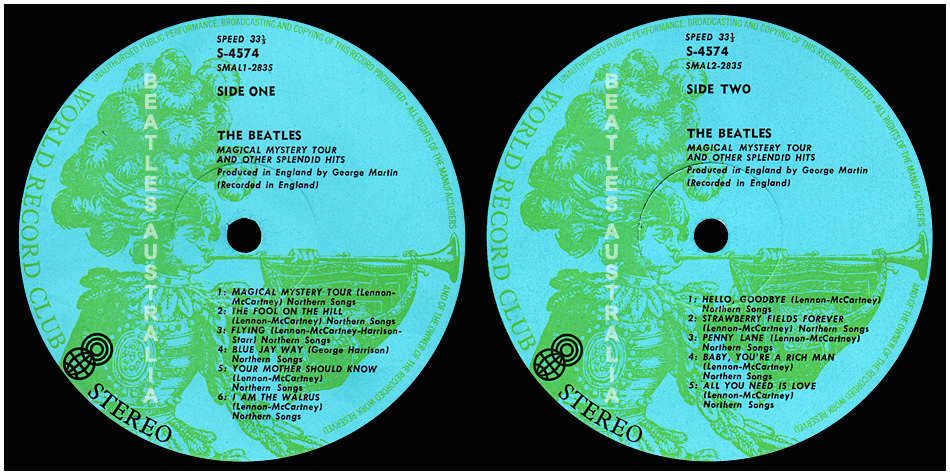
The only Beatles LP released on the WRC imprint was Magical Mystery Tour And Other Splendid Hits, issued in June 1969. The LP appeared on two main label styles, each with minor typesetting variations. The first was the classic WRC "S" stereo label, featuring a large white letter "S" over a blue-green base, surrounded by a black-and-white striped border. The second style, introduced in August 1972, featured an 18th-century trumpeter in green against a blue background. The "STEREO" text was later dropped from the label perimeter in 1979.
In addition to Magical Mystery Tour..., WRC occasionally made other Beatles titles available to its members. These, however, were not dedicated WRC pressings, but standard EMI (Australia) production-stock releases, distinguishable as club offerings only by a small sticker affixed to the (rear) packaging. Examples are shown under individual album pages (the 20th Anniversary Singles Collection also received a WRC release). This practice continued well into the Record Clubs of Australia era, and by 1987 members could purchase the full Beatles catalogue through the club on LP, cassette or CD.
Only one label pair per title is displayed on this page. Label variations for a given record can be found on its corresponding LP page (accessible via the main 'LPs' menu, above).
After a difficult first year, WRC began to find its feet in 1957. Encouraged by the club's growing success, Day turned his attention to Australia, establishing a Melbourne-based counterpart later that year. He eventually became its chief executive in 1963, while a New Zealand club followed several years after the Australian launch.
WRC issued LPs and tapes, predominantly classical and jazz titles, through a membership-based mail-order system. In Australia, manufacture was handled by EMI (Australia) through a 10 year agreement signed 3 April 1959. EMI (Australia) ultimately purchased WRC from EMI UK in early 1969, eventually assuming full control in 1975.
With the WRC becoming considerably less profitable—partly because changes to sales tax arrangements imposed the full tax burden on stock supplied through record clubs—EMI (Australia) made the decision in early 1983 to relocate the club from Melbourne to Sydney in an attempt to make it viable. The club relocated to EMI's Homebush premises, with its master tapes transferred to the tape basement at 301 Castlereagh Street, Sydney.
The following year, WRC and its principal rival, the CBS-owned Australian Record Club, were acquired by International Direct Marketing. The company was led by Brian Harris, former general manager of EMI (Australia), and Daryl Harbrecht, who had headed CBS Records' Australian Record Club for twenty years. The two clubs were subsequently consolidated under Record Clubs of Australia (Pty Ltd), with former EMI employee Aub Hogno appointed to oversee the combined operation.
Despite its promising early performance, the combined operation did not remain financially successful for long, entering receivership in February 1986. The business was acquired from the receiver by direct-marketing and media entrepreneur Joseph Schwartz, head of the Winns group of companies, who injected fresh capital in an effort to revitalise the club.
In late 1989, Record Clubs of Australia was purchased by Time Life Books, creating a direct-marketing operation that effectively challenged Reader’s Digest for the position of Australasia’s largest direct marketer of recorded music.
The only Beatles LP released on the WRC imprint was Magical Mystery Tour And Other Splendid Hits, issued in June 1969. The LP appeared on two main label styles, each with minor typesetting variations. The first was the classic WRC "S" stereo label, featuring a large white letter "S" over a blue-green base, surrounded by a black-and-white striped border. The second style, introduced in August 1972, featured an 18th-century trumpeter in green against a blue background. The "STEREO" text was later dropped from the label perimeter in 1979.
In addition to Magical Mystery Tour..., WRC occasionally made other Beatles titles available to its members. These, however, were not dedicated WRC pressings, but standard EMI (Australia) production-stock releases, distinguishable as club offerings only by a small sticker affixed to the (rear) packaging. Examples are shown under individual album pages (the 20th Anniversary Singles Collection also received a WRC release). This practice continued well into the Record Clubs of Australia era, and by 1987 members could purchase the full Beatles catalogue through the club on LP, cassette or CD.
Only one label pair per title is displayed on this page. Label variations for a given record can be found on its corresponding LP page (accessible via the main 'LPs' menu, above).
'S'
'TRUMPETER'